
August 2025

Discoveries, trends, and discussions in medical diagnostics

Let's connect

Fill out the form below to have a Quest representative contact you.

Please remember that email, including this web form, is not a secure method of communication. Do not submit personal information, including usernames and passwords, social security numbers, or personal health information through this form.

*Required

Better outcomes


Better outcomes


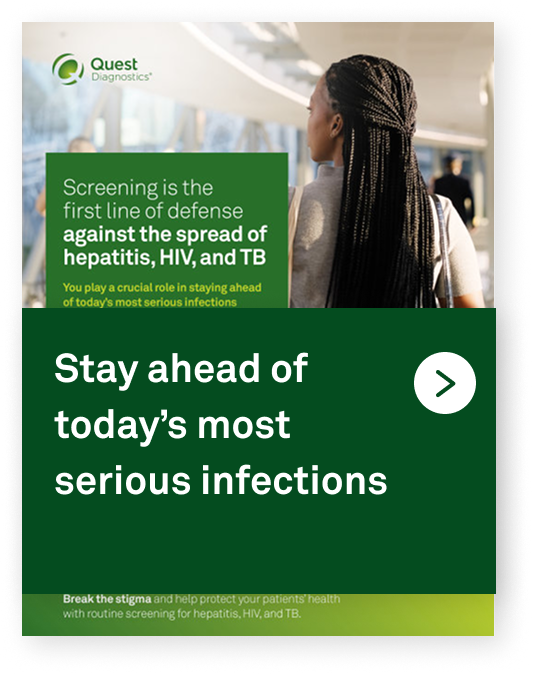
Screening is the first line of defense against the spread of hepatitis, HIV, and TB

When it comes to infectious diseases like hepatitis B (HBV) and hepatitis C (HCV), HIV, or tuberculosis (TB), coinfection is prevalent. Factoring coinfection into your screening decisions can help prevent transmission, connect patients to care more quickly, and improve outcomes.
  • There is high prevalence of chronic HBV and HCV infections among patients with TB1
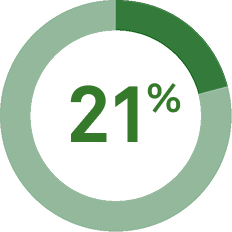
  • Approximately 21% of people with HIV also test positive for HCV2
Recommended screening guidelines help you protect patients
HBV and HCV
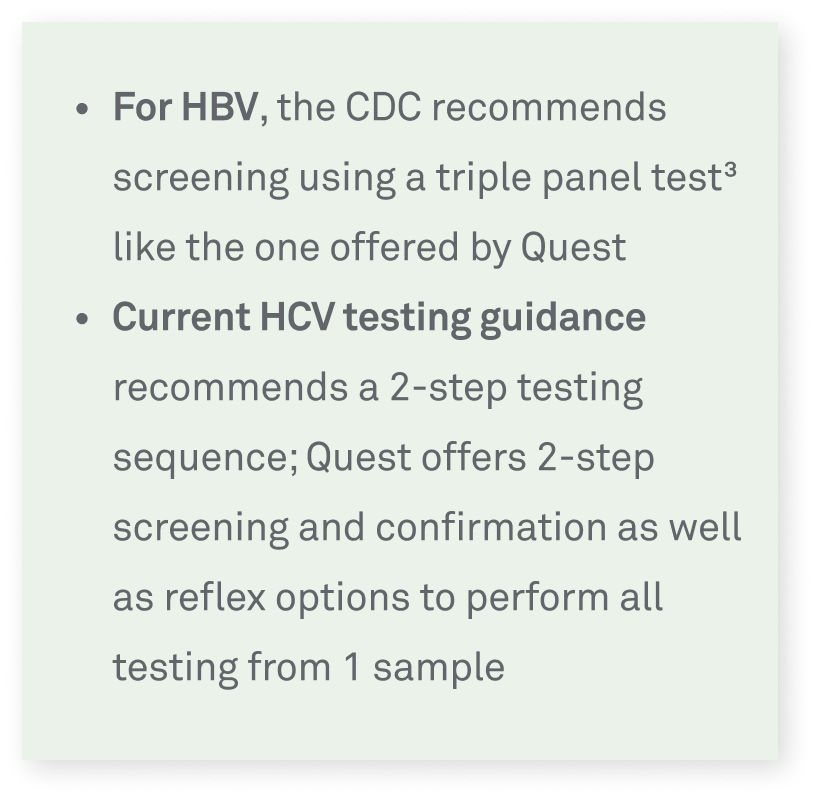
  • All adults at least once in their lifetime3
  • All pregnant people during each pregnancy, preferably in the 1st trimester3
  • Infants born to HBV- or HCV-infected people3
  • People with continued risk for HBV and HCV infection should be screened periodically
HIV
  • One-time testing is recommended for all individuals ages 13–654
  • People engaging in risky behaviors should get tested at least once every year5
TB
  • The USPSTF recommends screening for latent tuberculosis infection in populations at increased risk.6 The US FDA has approved 2 interferon gamma release assay (IGRA) blood tests: T-SPOT®.TB and QuantiFERON®-TB Gold Plus (QFT-Plus). Learn more at QuestIDScreening.com

Webinar: The evolving role of biomarkers in Alzheimer's risk assessment

The diagnostic landscape for Alzheimer’s disease is shifting rapidly. While cognitive assessments remain foundational, the emergence of blood-based biomarkers, in conjunction with cognitive assessment, offers clinicians a faster, less invasive, and more scalable path to diagnosis. These innovations are not only advancing clinical practice but also reshaping performance guidelines and staging criteria.
A conversation on today’s evolving Alzheimer’s diagnostic strategies
In this webinar, Quest Diagnostics experts Michael K. Racke, MD, Medical Director and neurology specialist, and Matthew Stroh, PhD, Medical Science Liaison, walk through the clinical evolution of Alzheimer’s diagnostics—from traditional tools to today’s biomarker-supported care models.
You’ll gain insight into
  • The progression of diagnostic strategies in Alzheimer’s disease
  • Updated performance criteria and staging guidelines
  • Real-world integration of blood-based biomarkers in today’s care pathways

Whether you’re just beginning to explore biomarker testing or already incorporating it into your neurology practice, this webinar offers forward-looking guidance you can use today.

Better experiences


Better experiences


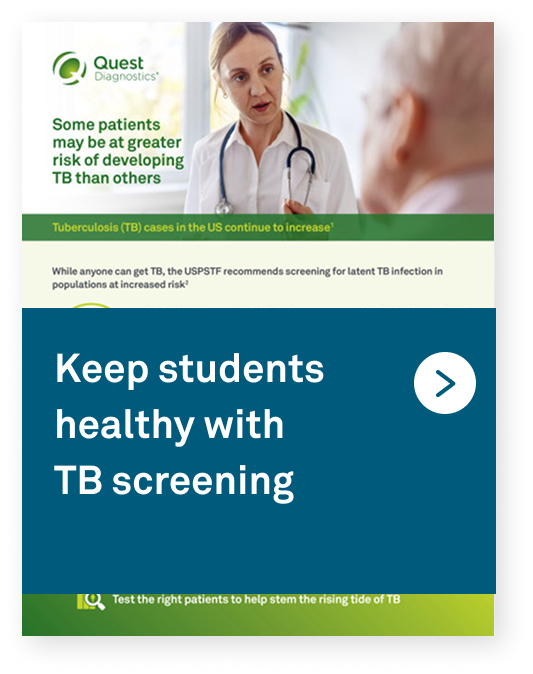
TB is on the rise—and school season is the smart time to test

After nearly 30 years of decline, tuberculosis (TB) is making a comeback in the US—with more than 10,000 cases reported in 2024 alone.7
As students and school staff prepare to return to classrooms, TB screening remains a critical step, particularly for those who have traveled internationally or those who live in/work in high-risk congregate settings.
IGRA blood tests are the preferred method for TB screening
Leading health organizations, including the CDC and WHO,8,9 recommend interferon gamma release assays (IGRAs) for their accuracy, convenience, and clinical utility.

IGRA tests offer:

A single visit: 1 tube, 1 draw, no return visit required

Improved accuracy: Fewer false positives in BCG-vaccinated individuals8,9

Faster, more efficient workflows for both providers and patients

Support safe, smooth school reentry with TB testing from Quest
Quest Diagnostics offers a choice of TB blood tests—helping you streamline care, meet school health requirements, and contribute to broader TB prevention efforts.

Removing traditional barriers to testing 


Removing traditional barriers to testing 


Removing traditional barriers to testing 


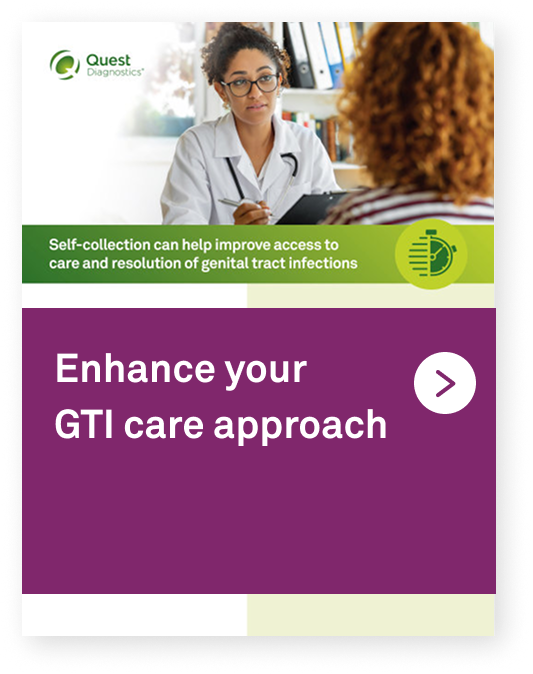
Improve access to GTI care with self-collected vaginal swabs

Genital tract infections (GTIs) like vaginitis can have serious health consequences if left untreated—from chronic pelvic pain and complications in pregnancy to an increased risk of HIV. Self-collection offers a simpler way to support faster diagnosis and treatment—without disrupting your workflow.
Self-collection supports timely, targeted care
FDA-cleared Aptima® multi-test vaginal swabs are available for self-collection, giving patients a convenient alternative to provider-collected samples. Available both in your office and at our Patient Service Centers, this option helps improve access while supporting continuity of care.

Accurate results ready for review at the patient’s follow-up visit

Streamlined ordering through Quanum®, your EHR, or printed requisitions

Easy-to-follow instructions for patients collecting their own sample

This simple solution can expand access, ensure appropriate follow-up, and support better outcomes for those at risk.

Clinical drug monitoring is critical—International Overdose Awareness Day serves as a reminder


International Overdose Awareness Day: The importance of clinical drug monitoring  


International Overdose Awareness Day: The importance of clinical drug monitoring  


International Overdose Awareness Day: The importance of clinical drug monitoring  


After years of steady increases, overdose deaths in the US are finally declining.10 Following a record high of more than 107,000 deaths in 2022, fatalities declined in 2023, and early 2024 data show a dramatic drop to approximately 80,000 deaths, the lowest total since 2019.11

While this progress is promising, overdose remains a leading cause of preventable death.12 As International Overdose Awareness Day on August 31 approaches, we reaffirm our commitment to helping you protect patients at risk.

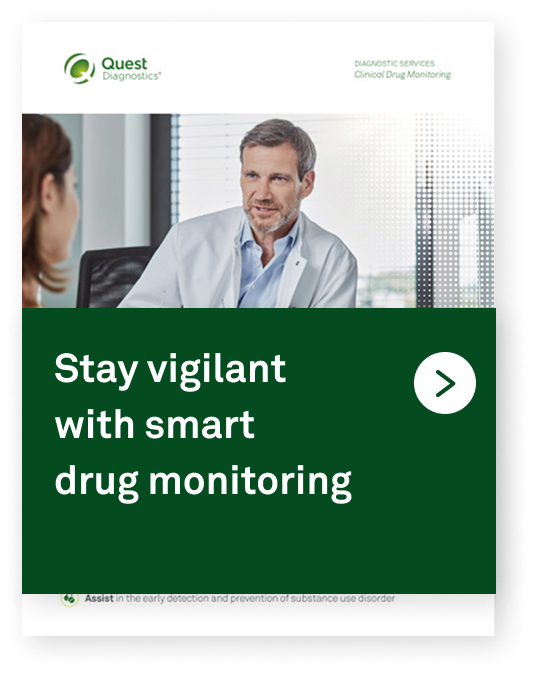
Clinical drug monitoring remains one of the most effective tools in the fight against drug misuse—supporting safe prescribing, early detection of misuse, and more informed care.

Medication monitoring can help you
  • Detect undisclosed or unexpected drug use
  • Prevent dangerous drug–drug interactions
  • Identify early signs of misuse or substance use disorder

Quest Diagnostics is here to support you with

  • A broad, up-to-date test menu covering both prescribed and nonprescribed substances
  • Fast, reliable results with easy-to-read reports
  • Access to toxicology and clinical experts for personalized support
Achieving the Quadruple Aim in your practice
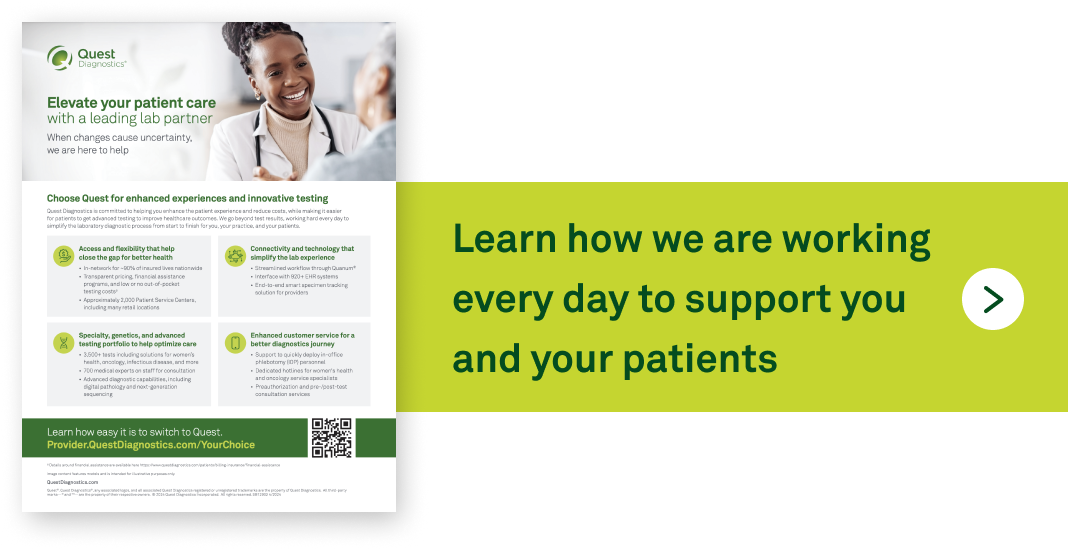

Our purpose is to support you and your patients with leading services, patient experiences, and innovative testing that can help you provide clarity to the constant changes and challenges we’re seeing in healthcare today.

About Diagnostics Dialogue

In our conversations with providers across the country, we hear that you are facing many different constraints that make delivering care challenging. We’re here to help you navigate the uncertainty and deliver better health. With a broad test menu spanning 3,500+ tests and consultations from our medical staff of over 850 MDs and PhDs, we empower healthcare providers to create healthier communities, one patient at a time.

References
  1. Olaru I, Beliz Meier M, Mirzayev F, et al. Global prevalence of hepatitis B or hepatitis C infection among patients with tuberculosis disease: systematic review and meta-analysis. eClinicalMedicine. 2023;58:101938. doi:10.1016/j.eclinm.2023.101938
  2. CDC. Viral hepatitis among people with HIV. January 31, 2025. Accessed August 7, 2025. https://www.cdc.gov/hepatitis/hcp/populations-settings/hiv.html
  3. CDC. Clinical testing and diagnosis for hepatitis B. January 31, 2025. Accessed July 11, 2024. https://www.cdc.gov/hepatitis-b/hcp/diagnosis-testing/index.html
  4. CDC. Clinical testing guidance for HIV. Published April 24, 2024. Accessed June 25, 2024. https://www.cdc.gov/hivnexus/hcp/diagnosis-testing/index.html
  5. HIV.gov. Who should get tested? Updated March 6, 2023. Accessed July 12, 2024. https://www.hiv.gov/hiv-basics/hiv-testing/learn-about-hiv-testing/who-should-get-tested
  6. US Preventive Services Task Force. Screening for latent tuberculosis infection in adults: US Preventive Services Task Force Recommendation Statement. JAMA. 2023;329(17):1487–1494. doi:10.1001/jama.2023.4899
  7. CDC. Tuberculosis data. March 12, 2025. Accessed June 3, 2025. https://www.cdc.gov/tb-data/2024-provisional/index.html
  8. CDC. Latent tuberculosis infection: a guide for primary health care providers. April 2024. Accessed November 4, 2024. https://www.cdc.gov/tb/media/pdfs/Latent-TB-Infection-A-Guide-for-Primary-Health-Care-Providers.pdf
  9. Biology insights. What Is an IGRA test for tuberculosis? July 27, 2025. Accessed August 7, 2025. https://biologyinsights.com/what-is-an-igra-test-for-tuberculosis/
  10. National Center for Health Statistics.Drug overdose deaths in the United States, 2003–2023. CDC.gov. Published May 2024. Accessed July 6, 2025. https://www.cdc.gov/nchs/products/databriefs/db522.htm
  11. Prevention Technology Transfer Center (PTTC) Network.US overdose deaths drop 26.9% in 2024. PTTCNetwork.org. Published June 2, 2025. Accessed July 6, 2025. https://pttcnetwork.org/news/u-s-overdose-deaths-drop-26-9-in-2024
  12. National Center for Injury Prevention and Control.About overdose prevention. CDC.gov. Published June 12, 2025. Accessed July 6, 2025. https://www.cdc.gov/overdose-prevention/about/index.html
Image content features models and is intended for illustrative purposes only.